Ford Mustang VIN Decoder: Full History, Generations and VIN Lookup Guide
Every Ford Mustang built since 1981 carries a 17-character Vehicle Identification Number, and learning to read it is the quickest way to find out what a car really is before you trust anyone’s description of it. The VIN confirms the model year, the factory it came from, the engine the car left the line with, the body style and the restraint system. When you are buying a used Mustang, checking an import, verifying that a GT or a Shelby is genuine, or simply ordering the right parts, those few characters settle arguments that a listing photo never can. If the decoded data and the seller’s story disagree, that gap is usually the first thing worth investigating. You can run any Mustang VIN through the decoder at the top of this page and get the result in a few seconds. The rest of this guide explains how those numbers are put together, walks through every generation of the car, and points out the model-specific details that actually matter when you check one.
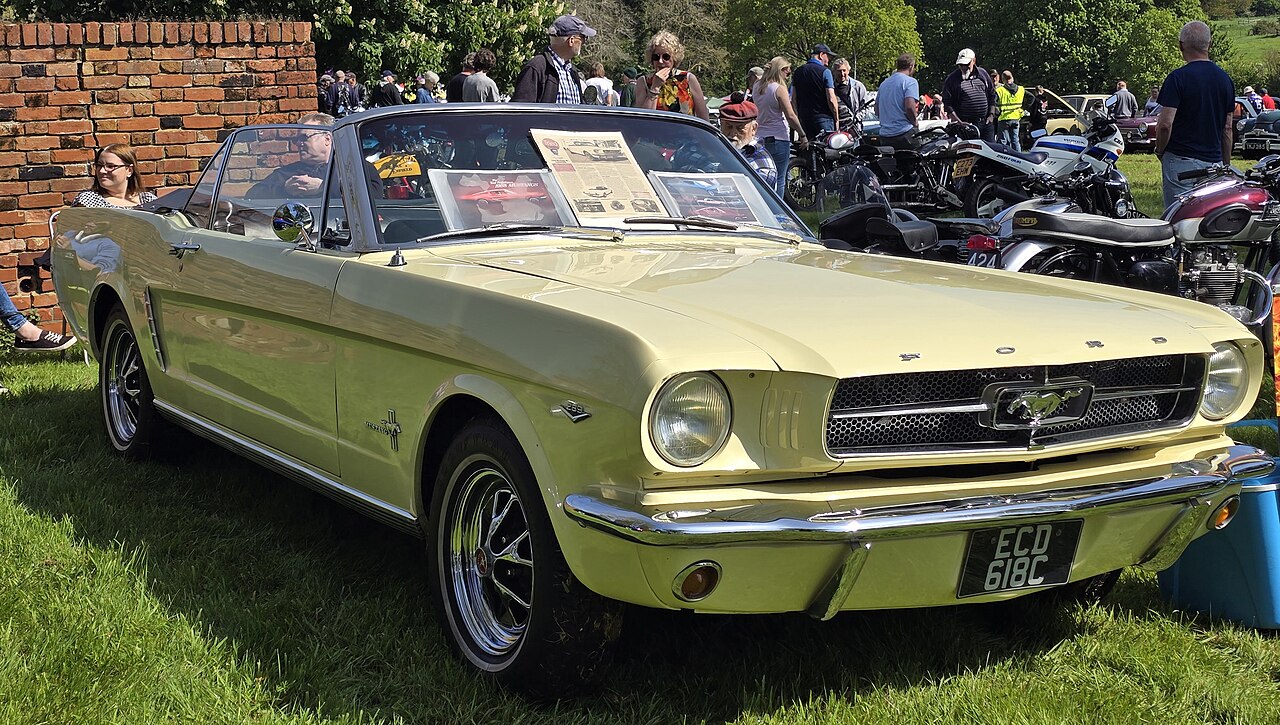
How a Ford Mustang VIN is put together
The 17 characters are not random. They break into three blocks, and because the layout follows a global standard, the same position always carries the same kind of information. The first three characters are the World Manufacturer Identifier, which tells you who built the car and where. Mustangs use two main codes. Cars starting with 1FA were built by Ford in Dearborn, Michigan, which covers most of Mustang history including the 1981 to 2004 cars and everything from 2015 onward. Cars starting with 1ZV came from Auto Alliance International at Flat Rock, Michigan, and that code points specifically to the fifth-generation S197 cars built from 2005 to 2014. Characters four through eight describe the car itself: the body style, the restraint system, the series, and most importantly the engine. This is the part of the VIN that separates a V8 GT from a turbocharged EcoBoost or an older V6, and it is where the Shelby variants are set apart from the standard car. The ninth character is a check digit, a value calculated from all the others to catch typos and obvious fakes. If that digit does not add up, the VIN is wrong, and on a collector car that is a serious red flag. The last eight characters tell you about the individual vehicle. Position ten is the model year, position eleven is the assembly plant, and the final six characters are the sequential build number that is unique to that one car. The quick reference below covers the clues you will use most often when you read a Ford Mustang VIN.
| VIN clue | What it means |
|---|---|
| WMI 1FA | Ford Mustang built by Ford in Dearborn, Michigan |
| WMI 1ZV | Ford Mustang built by AAI in Flat Rock, Michigan (2005 to 2014) |
| Position 9 | Check digit that validates the whole VIN |
| Position 10 | Model year code (for example M is 2021, R is 2024) |
| Position 11 = F | Dearborn assembly plant |
| Position 11 = 5 | Flat Rock assembly plant |
One thing to keep in mind is that this logic only applies to cars built from 1981 onward. Earlier Mustangs use shorter factory numbers, often eleven to thirteen characters, with a completely different layout, so a first or second generation car has to be read with year-specific references rather than a modern decoder. On any of these cars you will find the number at the base of the windshield on the driver’s side, on the certification label in the driver’s door jamb, and on the registration and insurance paperwork.
Ford Mustang VIN position by position
Modern Mustangs, from the 1981 model year on, use the seventeen character VIN. Read it in order and it gives you the country, the year, the plant and the engine family. The classic cars from 1965 to 1980 use a shorter Ford number that is read differently, and that older format is covered further down.
| Position | Name | What it tells you on a Mustang |
|---|---|---|
| 1 to 3 | World Manufacturer Identifier | 1FA for a Ford passenger car built in the United States |
| 4 to 8 | Vehicle descriptor | Body style, restraint system and engine, the part that separates a base car from a GT or a Shelby |
| 9 | Check digit | A calculated character that validates the rest of the VIN |
| 10 | Model year | A single character, listed in the chart below |
| 11 | Assembly plant | The Ford plant that built the car, Dearborn on the older cars and Flat Rock on the recent ones |
| 12 to 17 | Serial number | The build sequence unique to that Mustang |
Ford Mustang model year codes (position 10)
On any Mustang from 1981 on, the tenth character gives the model year. These are the codes for the cars most people are decoding today.
| Model year | Code in position 10 |
|---|---|
| Ford Mustang 2005 | 5 |
| Ford Mustang 2006 | 6 |
| Ford Mustang 2007 | 7 |
| Ford Mustang 2008 | 8 |
| Ford Mustang 2009 | 9 |
| Ford Mustang 2010 | A |
| Ford Mustang 2011 | B |
| Ford Mustang 2012 | C |
| Ford Mustang 2013 | D |
| Ford Mustang 2014 | E |
| Ford Mustang 2015 | F |
| Ford Mustang 2016 | G |
| Ford Mustang 2017 | H |
| Ford Mustang 2018 | J |
| Ford Mustang 2019 | K |
| Ford Mustang 2020 | L |
| Ford Mustang 2021 | M |
| Ford Mustang 2022 | N |
| Ford Mustang 2023 | P |
| Ford Mustang 2024 | R |
| Ford Mustang 2025 | S |
Decoding a classic Mustang, 1965 to 1973
The first generation cars predate the seventeen character VIN, and on these the very first character of the number is the model year. That single digit is the quickest way to place an early car. The characters that follow give the plant, the body style and the engine, all of which are spelled out on the door data plate as well.
| Model year | First character of the VIN |
|---|---|
| Ford Mustang 1965 | 5 |
| Ford Mustang 1966 | 6 |
| Ford Mustang 1967 | 7 |
| Ford Mustang 1968 | 8 |
| Ford Mustang 1969 | 9 |
| Ford Mustang 1970 | 0 |
| Ford Mustang 1971 | 1 |
| Ford Mustang 1972 | 2 |
| Ford Mustang 1973 | 3 |
Where to find the VIN on a Ford Mustang
On any recent Mustang read the VIN through the windshield at the base of the glass on the driver side, and check it against the label in the driver door jamb. On a classic look for the number on the inner wing or the door, with the matching details on the door data plate. On the collectible cars, a genuine GT or Shelby is worth confirming through the number rather than the badges, since these are among the most cloned Fords of all.
Reading a Mustang VIN in practice
Take a recent car whose VIN starts with 1FA and shows H in position ten. That marks it as a United States built Ford passenger car from the 2017 model year, with the descriptor section telling you whether it is a four cylinder EcoBoost, a V6 or a V8 GT. On a classic, a number that opens with 9 puts the car in 1969, and the door plate then confirms the body and the engine.
A short history, generation by generation
The Mustang has been in continuous production since 1964, across seven generations, and knowing which one you are looking at frames everything else about the car. The original cars, sold from early 1964 through 1973, invented the pony car class almost overnight. They came as hardtops, fastbacks and convertibles, with everything from frugal inline-six engines to small-block V8s and, later in the run, big-block performance motors. This era holds the most collectible classics, including the early Shelby GT350 and GT500 cars built with Carroll Shelby’s involvement, and none of them use the 17-character VIN. The second generation, the Mustang II of 1974 to 1978, arrived during the oil crisis and was downsized onto the Pinto platform. Enthusiasts tend to look down on it, but it sold strongly and kept the name alive through a hard decade. The Fox-body cars of 1979 to 1993 are where the Mustang found its second wind, and especially the 5.0 V8 GT and LX models of the late eighties became a tuning and drag-strip staple that still has a huge following. They are also the earliest Mustangs you can decode with a modern tool, since this is where the 17-character VIN begins. The SN95 generation that ran from 1994 to 2004, restyled with the cleaner New Edge look in 1999, brought the 3.8 V6 and the 4.6 modular V8 along with the hot SVT Cobra models, including the supercharged 2003 and 2004 Terminator Cobra. The S197 cars of 2005 to 2014 leaned hard into retro styling and were built at Flat Rock, which is why they wear the 1ZV code. The S550 cars from 2015 to 2023 finally gave the Mustang independent rear suspension as standard and sold it worldwide, and the current S650 has carried the formula forward since 2024 with a V8 and a manual gearbox still on the menu when most rivals have dropped both. The table below sums up the seven generations at a glance.
| Generation | Years | Body styles | Key engines | VIN type |
|---|---|---|---|---|
| Ford Mustang first generation | 1964 to 1973 | Hardtop, fastback, convertible | Inline-6, 289/302 and big-block V8 | Pre-1981 short VIN |
| Ford Mustang II | 1974 to 1978 | Coupe, hatchback | 2.3 I4, 2.8 V6, 302 V8 | Pre-1981 short VIN |
| Ford Mustang Fox-body | 1979 to 1993 | Coupe, hatchback, convertible | 2.3 I4, 5.0 V8 | 17-character |
| Ford Mustang SN95 | 1994 to 2004 | Coupe, convertible | 3.8 V6, 4.6 V8, SVT Cobra | 17-character |
| Ford Mustang S197 | 2005 to 2014 | Coupe, convertible | 4.0 V6, 4.6 and 5.0 V8 | 1ZV, Flat Rock |
| Ford Mustang S550 | 2015 to 2023 | Fastback, convertible | 2.3 EcoBoost, 5.0 V8, 5.2 Shelby | 1FA, Dearborn |
| Ford Mustang S650 | 2024 to present | Fastback, convertible | 2.3 EcoBoost, 5.0 V8, Dark Horse | 1FA, Dearborn |
Ford Mustang engines and specifications
Because the engine code sits in the middle block of the VIN, a proper check confirms the engine the car was born with, which is exactly what you want when you suspect a swap or a badge that does not match what is under the hood. The figures below cover the main modern configurations, with power quoted as a range because output changed across model years and trims.
| Configuration | Years | Power | Layout | Transmission |
|---|---|---|---|---|
| Ford Mustang 2.3 EcoBoost | 2015 to present | about 310 to 330 hp | Turbocharged inline-4 | Manual or automatic |
| Ford Mustang 3.7 V6 | 2011 to 2017 | about 300 to 305 hp | Naturally aspirated V6 | Manual or automatic |
| Ford Mustang GT 5.0 V8 | 2011 to present | about 412 to 486 hp | Naturally aspirated V8 | Manual or automatic |
| Ford Mustang Dark Horse 5.0 V8 | 2024 to present | about 500 hp | Naturally aspirated V8 | Manual or automatic |
| Ford Mustang Shelby GT350 5.2 V8 | 2015 to 2020 | about 526 hp | Flat-plane V8 | 6-speed manual |
| Ford Mustang Shelby GT500 5.2 V8 | 2020 to 2022 | about 760 hp | Supercharged V8 | 7-speed dual-clutch |
On classic and Fox-body cars the engine code separates the small-block 289, 302 and 351 engines from the big-block options, and that distinction can swing a car’s value dramatically, which is one more reason to confirm it against the VIN rather than the badge.
Ford Mustang by model year
Buyers searching for a specific year want to know what they are getting, so the table below maps recent model years to their VIN year code, generation and engine options. The same model-year letter logic runs right back through the earlier cars.
| Model year | VIN year code | Generation | Engine options |
|---|---|---|---|
| Ford Mustang 2019 | K | S550 | 2.3 EcoBoost, 5.0 V8, GT350 5.2 |
| Ford Mustang 2020 | L | S550 | 2.3 EcoBoost, 5.0 V8, GT350 and GT500 5.2 |
| Ford Mustang 2021 | M | S550 | 2.3 EcoBoost, 5.0 V8, GT500 5.2 |
| Ford Mustang 2022 | N | S550 | 2.3 EcoBoost, 5.0 V8, GT500 5.2 |
| Ford Mustang 2023 | P | S550 | 2.3 EcoBoost, 5.0 V8 |
| Ford Mustang 2024 | R | S650 | 2.3 EcoBoost, 5.0 V8, Dark Horse |
| Ford Mustang 2025 | S | S650 | 2.3 EcoBoost, 5.0 V8, Dark Horse |
Reliability and the things worth checking
Reliability depends heavily on the generation and the specific engine, and you should always confirm a given car against the NHTSA recall database using its VIN rather than relying on reputation alone. The most common points to check, by engine and area, are summarized below.
| Engine or area | What to check |
|---|---|
| Ford Mustang 5.0 V8 (Coyote) | Strong reputation overall, but some years drew reports of oil consumption and a tick or rattle, so confirm service history |
| Ford Mustang 2.3 EcoBoost | Mostly solid, with cooling-related concerns reported on certain years worth a closer look |
| Ford Mustang S197 V8 | Generally tough, but track and drag use is common, so inspect for hard use |
| Ford Mustang Fox-body and older | Age is the real issue: rust in rockers and floor pans, tired bushings, and the effects of past modifications |
Because Mustangs get modified and raced more than almost any other mainstream car, a VIN history check combined with a careful physical inspection counts for more here than it would on an ordinary commuter.
Ford Mustang recalls
Below are notable safety recalls recorded for the Ford Mustang by the American road safety regulator, the NHTSA, with a focus on the sixth generation from 2015 on. This is a reference list, not a check of your individual car. A recall applies only to certain build dates and VIN ranges, so a model year here does not mean every car of that year is affected.
| Model years | NHTSA number | Area | Problem and risk |
|---|---|---|---|
| 2015 to 2017 | 16V779 | Engine oil cooler | A hose can separate from the engine oil cooler tube and leak oil, which can cause engine failure or, near an ignition source, a fire. Oil cooler tube replaced. |
| 2015, 2.3L | 15V339 | Fuel tank | Underbody heat can degrade the fuel tank and vapor lines and cause a leak, and can also weaken the parking brake cable seals. Shield, thermal patches and wraps added. |
| 2015 | 14V774 | Fuel line | The fuel pressure sensor may not be seated properly on the fuel line, causing a fuel smell or leak and fire risk. Fuel jumper line replaced. |
| 2015 to 2017 | 25V614 | Seat belt pretensioner | Water and road salt can corrode the front seat belt pretensioner cables, which can break and leave the belt unable to restrain properly in a crash. Assemblies inspected and replaced. |
| 2015 | 16V643 / 20V331 | Door latches | A part in the door latch can break so a door may not stay latched and could open while driving. Latches replaced with an improved part. |
| 2015 | 14V649 | Passenger airbag sensor | The passenger belt tension sensor can misjudge occupant size, so the front airbag may deploy in the wrong way. Passenger belt buckle replaced. |
| 2015 to 2017 | 22V082 | Rear camera | Loose or damaged decklid wiring can leave the rearview camera image blank or distorted. Wiring repaired or camera replaced. |
| 2018 | 18V213 | 10-speed transmission | A missing roll pin can cause loss of the Park function, so the car can roll away after being parked. Roll pin installed if missing. |
| 2021 to 2022 | 25V455 | Fuel pump | The low pressure fuel pump can fail and cause the engine to stall while driving. Remedy in development. |
| 2024 | 25V315 | Rear camera | A software error can delay, freeze or blank the rearview camera image in reverse. Software updated by a dealer or over the air. |
Recall data is published by the NHTSA and changes over time, so treat this as background rather than a substitute for the official record for your VIN.
Check a specific VIN for open recalls: use the official NHTSA recalls lookup or the Ford recall page. Both are free and show whether the work has already been done.
Buying a used Ford Mustang
When you find a car worth pursuing, decode the VIN first and make sure the model year, engine and plant line up with the advertisement, then run that same number through the NHTSA recall search to see whether anything is still outstanding. Confirm that the engine matches the badge, since a repainted V6 wearing GT trim is not unheard of, and on premium cars verify Shelby authenticity properly rather than trusting the emblems. Look hard for accident, track and modification history on the performance variants, and on older cars spend your time underneath checking the rockers, floor pans and rear wheel arches for corrosion. On anything collectible, originality is everything, so matching-numbers status is worth confirming before you talk price.
Trusted sources for VIN and history data
For official information, the NHTSA VIN decoder and recall search give you the U.S. federal vehicle record and any open safety recalls, while the Ford Heritage Vault holds Ford’s own archive of brochures and model data. For ownership and accident history you will need a reputable VIN history provider, and on many model years a Marti Report can confirm exactly how a Mustang was originally built and equipped.
Common questions
People often ask whether they can decode a 1960s or 1970s Mustang here, and the honest answer is that the standard 17-character decoding only applies to cars from 1981 onward, since earlier ones use shorter factory numbers that need classic-specific references. The other frequent question is how to tell a real GT or Shelby from a tribute, and that comes down to the engine and series codes in the VIN backed up by factory documentation, because badges on their own prove nothing. And if your VIN happens to start with 1ZV, that simply means you have a 2005 to 2014 car built at Flat Rock rather than at Dearborn. When you are ready, enter your Ford Mustang VIN in the decoder above to confirm the year, engine, plant and configuration, then use the advice here to make sure the car is genuinely what it claims to be.