Ford Escort VIN Decoder: History, Generations and VIN Lookup Guide
Every Ford Escort built since 1981 carries a 17-character Vehicle Identification Number, and decoding it is the quickest way to confirm what a given car really is before you trust a listing. The VIN reveals the model year, the plant it came from, the engine fitted at the factory, the body style and the safety equipment. On a used or classic Escort this matters most for confirming the engine, separating an ordinary car from a genuine RS2000 or RS Cosworth, and verifying the model year a seller claims. This page covers the European Ford Escort. Run any Escort VIN through the decoder above to read it in seconds, and use the guide below to understand the number and what to check.
How a Ford Escort VIN is put together
The 17 characters follow a global standard, so each position carries fixed meaning. The first three are the World Manufacturer Identifier, which depends on where the car was built. European Escorts were assembled mainly in the United Kingdom and Germany, and German-built cars typically begin with WF0, the Ford-Werke identifier. Characters four through eight describe the body, restraint system and engine, which is where a fast RS model is separated from a standard car. The ninth character is a check digit, the tenth is the model year, the eleventh is the plant, and the final six are the unique build sequence.
| VIN clue | What it means |
|---|---|
| WMI WF0 | Ford Escort built by Ford in Germany |
| Position 9 | Check digit that validates the whole VIN |
| Position 10 | Model year code (for example S is 1995, W is 1998) |
| Positions 4 to 8 | Body style, restraint system and engine family |
| Positions 12 to 17 | Unique sequential build number |
Escorts built before 1981 use shorter factory numbers with a different layout and must be read with year-specific references. You will find the VIN at the base of the windshield, on the door jamb label, and in the registration paperwork.
Ford Escort VIN position by position
Escorts from the 1981 model year on use the seventeen character VIN, which reads cleanly one position at a time. The earlier cars predate that system and carry a shorter Ford number, so the first step is to check which side of 1981 your Escort sits on.
| Position | Name | What it tells you on an Escort |
|---|---|---|
| 1 to 3 | World Manufacturer Identifier | WF0 marks a Ford built in Europe, the origin of the European Escort |
| 4 to 8 | Vehicle descriptor | Body style, trim and engine, where a base car is separated from an XR3i, an RS Turbo or a Cosworth |
| 9 | Check digit | A calculated character that validates the rest of the VIN |
| 10 | Model year | A single character, listed in the chart below |
| 11 | Assembly plant | The European Ford factory that built the car |
| 12 to 17 | Serial number | The build sequence unique to that Escort |
Ford Escort model year codes (position 10)
On the cars that carry the seventeen character VIN, the tenth character reads as follows.
| Model year | Code in position 10 |
|---|---|
| Ford Escort 1986 | G |
| Ford Escort 1987 | H |
| Ford Escort 1988 | J |
| Ford Escort 1989 | K |
| Ford Escort 1990 | L |
| Ford Escort 1991 | M |
| Ford Escort 1992 | N |
| Ford Escort 1993 | P |
| Ford Escort 1994 | R |
| Ford Escort 1995 | S |
| Ford Escort 1996 | T |
| Ford Escort 1997 | V |
| Ford Escort 1998 | W |
| Ford Escort 1999 | X |
| Ford Escort 2000 | Y |
Where to find the VIN on a Ford Escort
On the Escort the VIN is stamped on the body and shown on a plate in the engine bay, and on the later cars it also reads through the base of the windscreen. A genuine fast Escort, such as an RS Turbo or a Cosworth, is worth far more than a plain car, so confirm the number against the plate and the paperwork before you trust the badges.
Reading an Escort VIN in practice
Take a car whose VIN opens with WF0 and shows N in position ten. That places it as a European built Ford from the 1992 model year. The descriptor section then shows the body and the engine, and the closing six digits are the car’s own serial number.
Generations of the Ford Escort
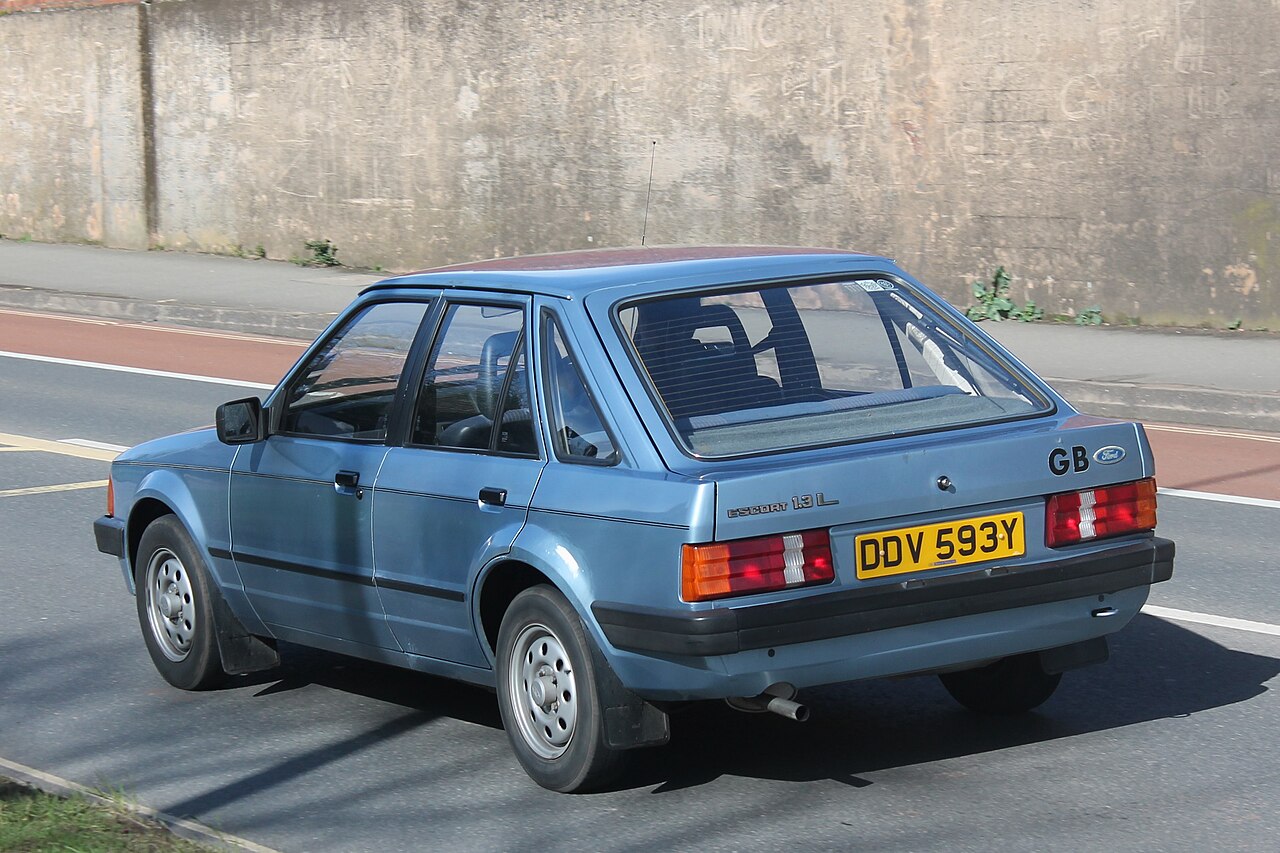
The Escort was one of Europe’s best-selling cars for decades. The first two generations were rear-wheel drive and are prized by classic and rally enthusiasts, the car switched to front-wheel drive in 1980, and the later generations through 2000 brought modern Zetec engines and the formidable all-wheel-drive RS Cosworth. The number you can decode with a modern tool starts with the 1981 and later cars.
| Generation | Years | Layout | Key engines | VIN type |
|---|---|---|---|---|
| Ford Escort Mk1 and Mk2 | 1968 to 1980 | Rear-wheel drive | 1.1 to 2.0, RS1600, RS2000 | Pre-1981 short VIN |
| Ford Escort Mk3 and Mk4 | 1980 to 1990 | Front-wheel drive | 1.1 to 1.6 CVH, XR3i, RS Turbo | 17-character |
| Ford Escort Mk5 and Mk6 | 1990 to 1995 | Front and all-wheel drive | 1.3 to 1.8, RS2000, RS Cosworth | 17-character |
| Ford Escort Mk7 | 1995 to 2000 | Front-wheel drive | 1.3 to 1.8 Zetec, 1.8 diesel | 17-character |
Ford Escort engines and specifications
Because the engine code sits in the middle of the VIN, a check confirms the engine the car was built with, which is exactly what you want on a model with so many variants and lookalike performance trims.
| Configuration | Years | Power | Notes |
|---|---|---|---|
| Ford Escort 1.4 and 1.6 petrol | 1986 to 2000 | about 70 to 90 hp | Common CVH and Zetec engines |
| Ford Escort 1.8 diesel | 1990 to 2000 | about 60 to 90 hp | Economy choice |
| Ford Escort RS2000 | 1991 to 1996 | about 150 hp | 2.0 sixteen-valve sports model |
| Ford Escort RS Cosworth | 1992 to 1996 | about 227 hp | 2.0 turbo, all-wheel drive |
Ford Escort by model year
The Escort follows the standard VIN year characters, so position ten quickly confirms the year a seller claims for the later cars.
| Model year | VIN year code | Notes |
|---|---|---|
| Ford Escort 1993 | P | Mk5b, RS2000 and RS Cosworth available |
| Ford Escort 1995 | S | Transition to Mk7 |
| Ford Escort 1997 | V | Mk7 with Zetec engines |
| Ford Escort 1999 | X | Late-run cars |
| Ford Escort 2000 | Y | Final European model year |
Reliability and the things worth checking
As an older car, the Escort’s condition matters far more than its original specification. Confirm a specific car against the relevant records by its VIN where possible.
| Area | What to check |
|---|---|
| Ford Escort bodywork | Rust is the main enemy: inspect arches, sills, floors and suspension mounts thoroughly |
| Ford Escort RS Cosworth | Authenticity and originality are critical to value; verify the car is genuine and unmodified where it matters |
| Ford Escort engines | Confirm cambelt history on Zetec engines and general service records |
| Ford Escort general | Check for past accident repair and matching identification details |
A VIN check together with a careful inspection, especially for rust and authenticity on the RS models, is essential on a car of this age.
Buying a used Ford Escort
Decode the VIN first and confirm the model year, engine and body match the advertisement. On ordinary cars, condition and rust matter most, while on the sought-after RS2000 and RS Cosworth, originality and a documented history are everything and command a large premium. Always confirm a performance model through the VIN and paperwork rather than the badges, since replicas exist.
Common questions
Buyers often ask how to confirm a genuine RS Cosworth or RS2000, and the answer is in the engine and series codes of the VIN backed up by factory documentation and history, because these cars are widely replicated. People also ask whether a 1970s Escort can be decoded here, and the answer is that the standard 17-character tool only covers 1981 and newer cars. The earlier rear-wheel-drive Escorts need classic-specific references. When you are ready, enter your Ford Escort VIN in the decoder above to confirm the year, engine and configuration before you buy.