Ford Anglia VIN Decoder: History, Engines and VIN Lookup Guide
Every Ford Anglia carries an identification number, and reading it is the quickest way to confirm what a particular car really is before you trust a seller’s description. The Anglia was Ford of Britain’s small car from 1939 to 1967, best remembered for the 105E with its distinctive reverse slanted rear window. Because the Anglia was built long before the modern 17 character VIN, it uses a shorter chassis and serial number, and reading it confirms the model and roughly when the car was built. You can run an Anglia number through the decoder at the top of this page, and the guide below explains the classic format, walks through the generations, and points out what matters most when you check one.
How a Ford Anglia VIN is put together
The Anglia predates the 17 character VIN that Ford adopted in 1981, so it carries a shorter chassis and serial number rather than a modern VIN. The number is stamped on a plate in the engine bay and on the body, and it identifies the model series and the individual car rather than packing in the detailed coded fields of a modern VIN. Because these cars are so old, the most reliable approach is to match the chassis number on the car with the number on the registration document and any history that comes with it. An owners club or marque specialist can confirm what a correct number looks like for a given year and model. The quick reference below covers the clues you will use most often when you read a Ford Anglia number.
| VIN clue | What it means |
|---|---|
| Chassis and serial number | Stamped on a plate in the engine bay and on the body |
| Model series code | For example 100E, 105E or 123E |
| Engine | Side-valve on early cars, the Kent OHV unit on the 105E and 123E |
| Registration document | Should match the chassis number on the car |
| Production records | Owners clubs can confirm a correct number for the year |
On a car this old, matching the chassis number with the paperwork is the first and most important check.
How a Ford Anglia is identified
The Anglia is far older than the seventeen character VIN, so it does not have one. A British Ford of this era is identified by its chassis number, stamped on the car and shown on the identification plate in the engine bay. On the later cars a serial number ties the body to Ford’s records. There is no modern position by position code to read, so the plate and the stamped number, checked against the paperwork, are what establish the car.
Where to find the number on a Ford Anglia
Look for the identification plate in the engine bay, usually on the inner wing or the bulkhead, and for the stamped chassis number on the body. On a car of this age the plate, the stamped number and the registration documents all need to agree. A car whose plate is missing or whose numbers do not match is much harder to value, so check carefully before you buy.
Reading an Anglia number in practice
Rather than decoding positions as on a modern VIN, you match the chassis and serial numbers against Ford records and the Anglia owners clubs to place the car and confirm its history. The clubs keep the knowledge that turns an old number into a year and a specification, so on a car this age they are the best place to verify what you have, particularly on the sought after 105E.
A short history, generation by generation
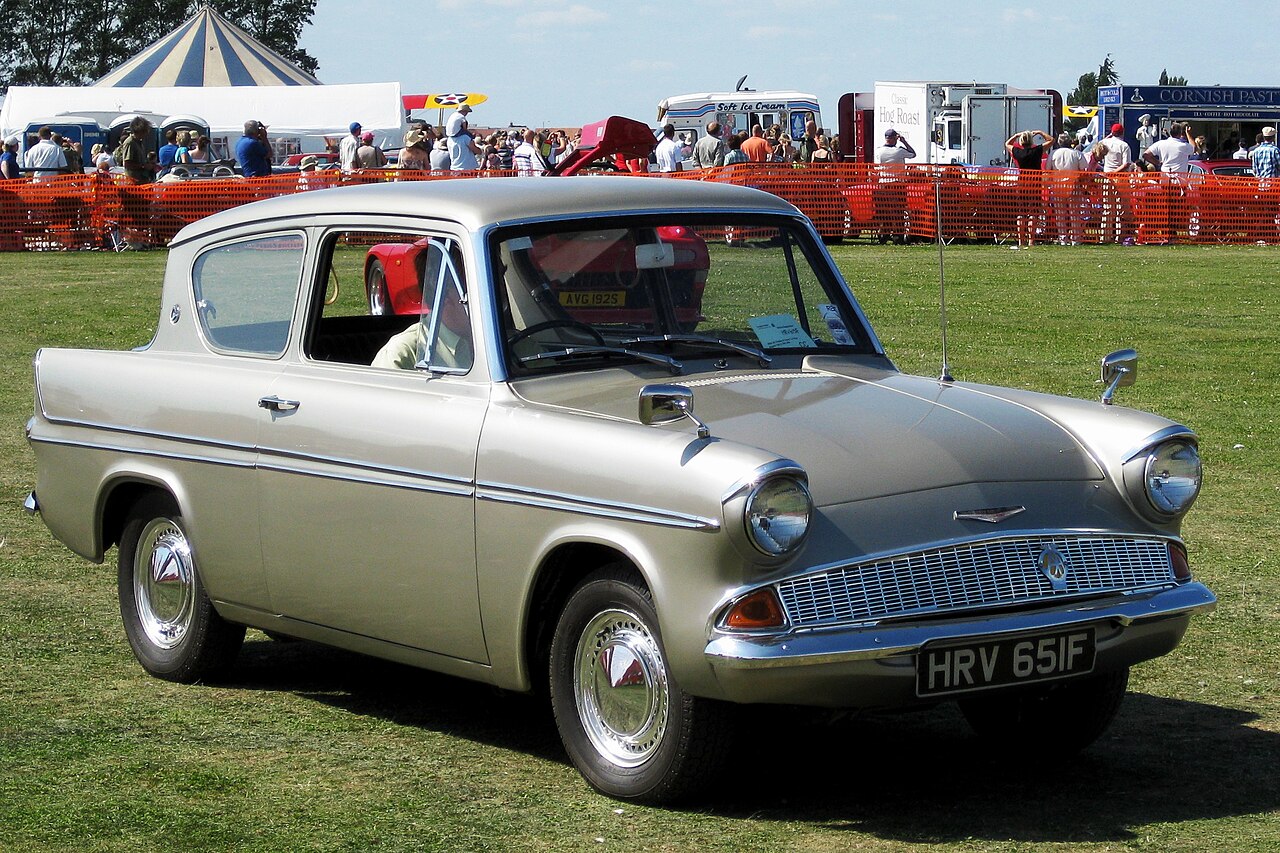
The Anglia name first appeared in 1939 on a simple side-valve small car, and it carried Ford through the post war years as cheap, dependable transport. The 100E of 1953 brought more modern styling while keeping a side-valve engine, but it was the 105E of 1959 that made the Anglia famous, with its reverse slanted rear window and the new overhead valve Kent engine that would go on to power countless Fords. The 123E added a larger engine before the Anglia gave way to the Escort in 1967. The table below sums up the generations.
| Generation | Years | Body styles | Key engines |
|---|---|---|---|
| Ford Anglia E04A and E494A | 1939 to 1953 | Saloon | Side-valve four |
| Ford Anglia 100E | 1953 to 1959 | Saloon | 1.2 side-valve four |
| Ford Anglia 105E and 123E | 1959 to 1967 | Saloon, estate | 997 and 1198 Kent OHV |
Ford Anglia engines and specifications
Because the engine is central to what an Anglia is worth, confirming it against the car is well worth doing. The figures below cover the main engines, with power as a range because output changed across the years.
| Configuration | Years | Power | Layout |
|---|---|---|---|
| Ford Anglia side-valve | 1939 to 1959 | about 30 to 36 hp | Side-valve inline-4 |
| Ford Anglia 997 Kent | 1959 to 1962 | about 39 hp | OHV inline-4 |
| Ford Anglia 1198 Kent | 1962 to 1967 | about 48 hp | OHV inline-4 |
Ford Anglia by model year
Buyers searching for a specific year want to know what they are getting, so the table below maps several years to the model series and engine. These cars predate the 17 character VIN and are identified by their chassis number.
| Model year | Identification | Series | Engine |
|---|---|---|---|
| Ford Anglia 1955 | chassis number | 100E | 1.2 side-valve |
| Ford Anglia 1960 | chassis number | 105E | 997 Kent |
| Ford Anglia 1963 | chassis number | 123E | 1198 Kent |
| Ford Anglia 1966 | chassis number | 105E and 123E | 997 to 1198 Kent |
Reliability and the things worth checking
The Anglia is mechanically simple and easy to maintain, but every survivor is now a classic, so condition and originality matter far more than complexity. The most common points to check are summarized below.
| Engine or area | What to check |
|---|---|
| Ford Anglia Kent engine | Robust and easy to rebuild, check for wear and oil leaks |
| Ford Anglia body | Rust in floors, sills, arches and around the rear window is the main enemy |
| Ford Anglia originality | Confirm the chassis number matches the paperwork and the trim is correct |
| Ford Anglia parts | Mechanical parts are well supported, but trim and body panels can be harder to find |
Buying a used Ford Anglia
When you find one worth pursuing, read the chassis number first and make sure it matches the registration document and any history with the car. Spend most of your time checking for corrosion, which is the thing most likely to turn a tempting project into a major restoration, and confirm the car is complete, since missing trim can be hard to replace. When you are ready, enter your Ford Anglia number in the decoder above, then use the advice here to make sure the car is genuinely what it claims to be.